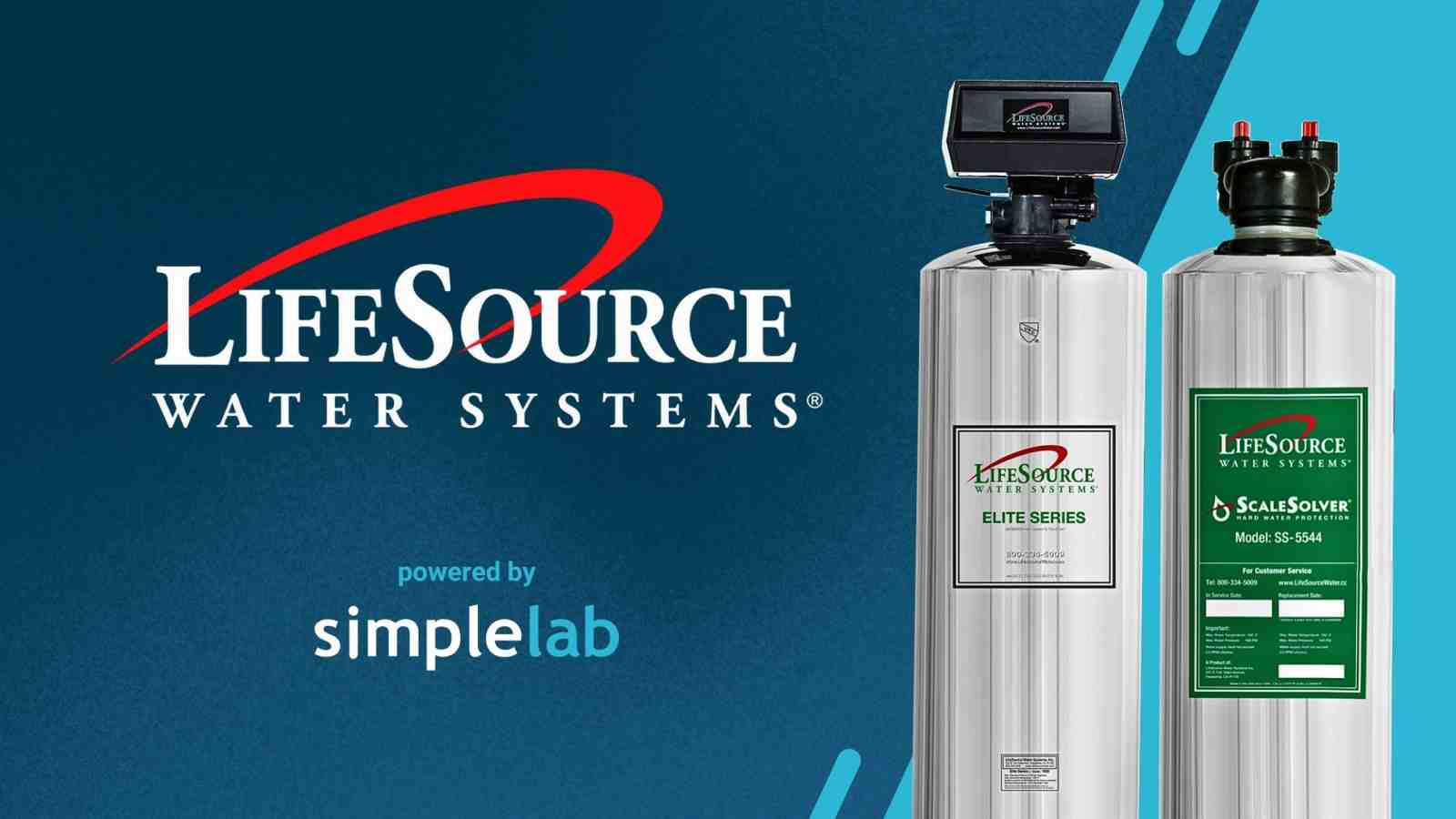
Powered by SimpleLab: LifeSource Water Systems
Featuring Bryan Harris, Chief Marketing Officer
Welcome to another edition of Powered by SimpleLab, a series where we spotlight real customers using SimpleLab to simplify laboratory testing, verify quality, and deliver trusted results at scale.
LifeSource Water Systems is a family-owned manufacturer of whole-house, salt-free water filtration and conditioning systems, founded in Pasadena, California in 1984. LifeSource introduced what it describes as the first whole-home, salt-free water filtration system, and the company has since installed more than 250,000 systems. LifeSource designs, manufactures, installs, and services its products itself in California, Arizona, Texas, and Nevada, and ships systems across the entire US. Now in its third generation of family leadership, LifeSource pairs long-life carbon filtration certified to 2.2 million gallons with its ScaleSolver™ salt-free scale control technology.
Water chemistry changes dramatically from one home to the next, and a recommendation is only as good as the information behind it. For homes on private wells, and for any homeowner who wants their own numbers rather than a utility average, LifeSource turns to certified laboratory analysis through SimpleLab. The result is a recommendation grounded in what is actually in the water, from a lab with no stake in what the homeowner decides to buy.
Meet Bryan!

Bryan Harris, LifeSource Chief Marketing Officer
For readers who don't know LifeSource yet, tell us what LifeSource does and what makes your approach different.
LifeSource makes whole-house water systems. Our systems filter the water at every tap in the home, not just the kitchen sink. LifeSource invented whole-house water filtration in 1984 as an alternative to old-fashioned water softeners.
Two things set us apart. First, we're salt-free. Our carbon tanks reduce chlorine and chloramine, and ScaleSolver helps prevent scale without adding salt to your water or the sewer. Second, we do the whole job ourselves. We build the systems in our own factory, our own certified teams install them, and we service what we install. There's no dealer in the middle.
With 250,000+ systems installed and three generations of family behind the brand, what does standing behind a system actually commit you to?
It means we're still there years after the sale. When a system needs attention, our people handle it.
It also commits us to honesty up front. If your water doesn't need what we sell, we should tell you. This is my family's company, and every install carries our name. We'd rather lose a sale or provide a refund than have unhappy customers.
In this industry, the "free water test" is the default, and it's usually a DIY strip at the kitchen sink. LifeSource built its water testing approach around laboratory analysis instead. How do you explain that difference to a homeowner?
A test strip is a quick read on a few things, usually hardness and chlorine. You match a color under kitchen lighting and make a judgment call. It's a fine way to start a conversation. It's not a diagnosis.
A lab test measures what's actually in your water and gives you real numbers. We use these tests primarily for well water. It's important to us that the test comes from a lab with no stake in what you buy. When the person running the test is the same person selling the fix, homeowners have every reason to be skeptical. Independent data takes that question off the table.
Where does water testing fit into the LifeSource experience?
For homes on city water, we start with what we know about that supply and the utility's annual water quality report. For well owners, or anyone who wants their own home's numbers, a certified lab test is the right starting point. That's where SimpleLab comes in.
You've expanded deliberately into California, Arizona, Texas, and Nevada. Those four states cover Colorado River supply, deep groundwater, and some of the hardest municipal water in the country. How does knowing what's actually in a home's water shape what you recommend?
It shapes almost everything. Colorado River water in Southern California, Phoenix, and Las Vegas tends to be hard and treated with chlorine or chloramine. Groundwater in parts of Arizona and Texas can be harder still, with a different mineral mix. A private well can be anything.
Same company, very different water. The numbers tell us how to size the system, which tanks to pair, and whether the home needs something we don't sell. Without data, you're guessing.
Water treatment marketing often leans on scary contaminant lists and urgency. LifeSource doesn't read that way. How do you get someone to take their water seriously without frightening them, and is that a harder sell?
City tap water in our markets meets federal standards. Telling people otherwise to close a sale is bad for the customer and bad for the industry.
So we talk about what people already notice. The chlorine smell in a hot shower. How the water or coffee tastes. How their skin and hair feel. Scale on the faucets. We just connect those things to the water.
Is it a harder sell? In the short run, maybe. Fear closes some deals faster. It also creates buyer's remorse and cancellations. We want to build trust with customers who will refer their friends and neighbors after they experience the LifeSource promise.
What changes in the conversation when a homeowner sees real data about their own water?
The question changes from "Do I need this?" to "What do I need?" Real numbers end a lot of debate. People stop asking whether the problem is real and start asking about the fix: how long the tanks last, what upkeep looks like, what it costs to own.
We explain less and answer more. And sometimes the data shows a family doesn't need the extra piece they were sure they wanted. Telling them that builds more trust than any pitch.
What do people most often misunderstand about water treatment?
Three things come up all the time.
First, that softening and filtering are the same thing. They're not. A salt softener swaps hardness minerals for sodium. It isn't built to deal with chlorine, taste, or odor. Filtration is.
Second, that a point of use filter is all you need. You also shower, bathe, cook, and do laundry with your water. A pitcher or fridge filter only covers what you pour.
Third, salt-free systems don't work. Salt-free scale control doesn't remove the healthy minerals. It changes how they behave, so they're less likely to stick to pipes, fixtures, and water heaters.
What would you say to others in this industry about the role of independent laboratory data?
What we get right: most people in this industry care about water and want families to have better water at home.
What we get wrong: too often the person selling the fix also runs the test, and the test is a strip and a color chart. That makes it too easy to find a problem.
Where I'd like to see it go: independent lab data as the starting point for any serious recommendation. Results explained in plain language. Recommendations that match the numbers. That's how this industry earns trust.
What are customers asking you about now that they weren't asking five years ago?
Five years ago it was mostly chlorine and hard water. Now people come in having read the headlines. They ask about PFAS, lead pipes, microplastics, and chloramine by name.
They also ask for proof: certifications, test results, reviews. And more of them ask about the environment, like the salt softeners send down the drain and the water reverse osmosis systems waste.
Anything else you'd want the industry to know about LifeSource, or about where you're headed next?
We've been at this for more than 40 years, and we're still family-run, now in our third generation. We're growing, but only into markets where we can do it right with our own teams. Austin and San Antonio are the newest.
The goal is simple. When people think about water at home, we want them to think of LifeSource. And we want to earn that the slow way, one honest recommendation at a time.
At SimpleLab, we're proud to support the businesses and teams working behind the scenes to verify quality, protect their customers, and make trusted drinking water more accessible. We're especially grateful to customers like LifeSource, who show what it looks like to let the data lead to the recommendation.
Stay tuned for more stories from our growing network of labs and businesses raising the bar for quality, safety, and testing access.
Follow LifeSource Water
Want to learn more about LifeSource? Follow them on Instagram to stay up to date on their latest work, or visit their website to see how their whole-house systems work. You can also find LifeSource Water Systems on LinkedIn and Facebook.
Share Your SimpleLab Story
If you're a current SimpleLab customer or partner and would like to be featured in an upcoming edition of Powered by SimpleLab, reach out to us at hello@gosimplelab.com.
Simplify Testing for Your Business
Managing water or environmental quality across multiple locations? Create an account to explore testing options and see how SimpleLab makes it easy to order, track, and manage laboratory testing in one place.
Jess leads the scientific program at SimpleLab and oversees all analytical and data products. She holds a PhD in water resources and a Master’s in Environmental Engineering from UC Berkeley.
About SimpleLab
SimpleLab combines world-class laboratory science with customer service to ensure testing your environment is simple, fast and factual. Everything we do is driven by data and supported by a team of experts ready to answer your questions.