Powered by SimpleLab: The Osman Lab at Stanford University
Featuring Khalid Osman, Assistant Professor of Civil and Environmental Engineering
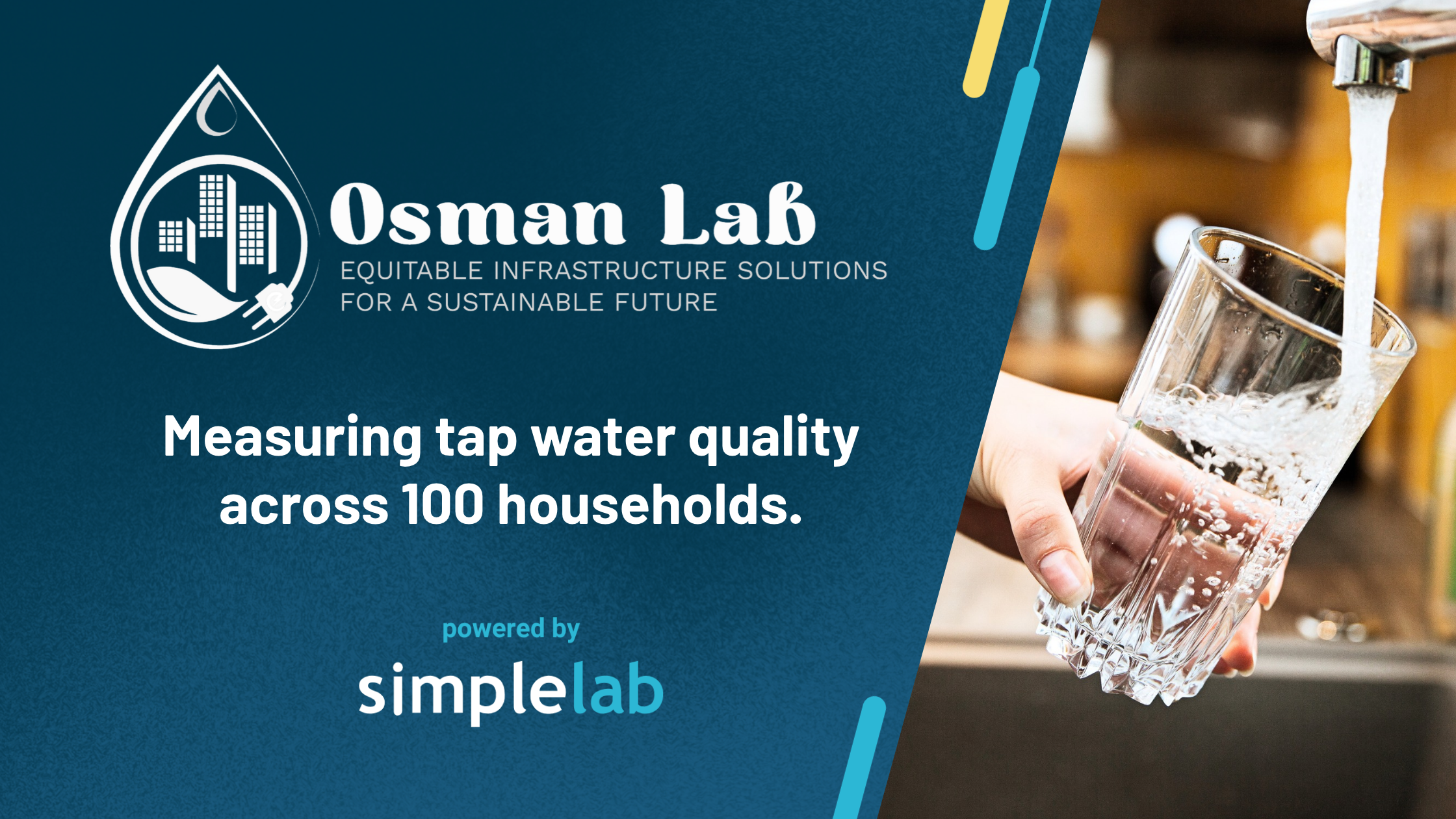
Why do some households distrust their tap water, and do those concerns match what's actually coming out of the tap? That's the question behind Tap Trust, a study on drinking water inequities led by Khalid Osman's research group at Stanford University, in collaboration with the UCLA Luskin Center for Innovation and community partners Nuestra Casa de East Palo Alto and We the People of Detroit. Their work is supported by Stanford Impact Labs.
Instead of taking a single sample from each home, the team followed roughly 100 households over time in East Palo Alto, California, and Detroit, Michigan. They paired repeated tap water samples with residents' own observations about how their water looked, tasted, and smelled. The design called for a broad testing panel, individualized kits, and a way to get understandable results back to every participating household.
SimpleLab supported the study from kit design and distribution to laboratory analysis and reporting, fulfilling 400 testing kits covering over 40 analytes. The results gave residents real answers: about 62% of households had at least one exceedance of a secondary drinking water standard (i.e., EPA's guidelines for aesthetic qualities like taste, odor, color, and staining), which means many of the concerns residents reported had a measurable basis.
"SimpleLab transformed how we managed large-scale tap water testing in our Tap Trust study. Their streamlined system made it effortless to coordinate sampling, track results, and deliver data back to participants—saving us significant time and resources." — Khalid Osman, Assistant Professor of Civil and Environmental Engineering and Center Fellow, Stanford University
Meet Khalid!

Khalid K. Osman, Assistant Professor of Civil and Environmental Engineering, Stanford University
Tell us a bit about yourself and your work.
I lead a research group focused on making water and other infrastructure systems more equitable, with much of my day-to-day work involving designing studies, working with students and community partners, and analyzing how infrastructure affects people's everyday lives. I also teach and mentor students while collaborating with utilities, community organizations, and other researchers to translate our findings into practical improvements in policy and practice.
Tell us about the Tap Trust study and the question at the center of it.
Tap Trust grew out of a simple question: Why do some households distrust their tap water, and how well do those concerns align with what is actually happening at the tap over time? We wanted to move beyond one-time water samples and system-level measures by repeatedly sampling water in people's homes while also documenting their perceptions, experiences, and water-use decisions. This felt especially important because concerns about drinking water quality and trust can persist even when a water system is meeting regulatory requirements, and those concerns can carry real financial and health-related consequences for households. Our goal was to better understand where those gaps come from and what utilities and communities might do to address them.
Who were the households, and how were they selected?
We worked with roughly 100 households in East Palo Alto, California, and Detroit, Michigan, two communities with distinct histories and experiences around drinking water quality, affordability, and trust. In East Palo Alto, households were served by several different water systems, which allowed us to examine variation even within the same geographic area, while Detroit provided a contrasting large municipal system. Participants were recruited with the help of community partners, with the goal of capturing a range of household experiences rather than producing a statistically representative sample of either city.
Coordinating 400 kits across 100 households is a real logistics challenge. What did managing that look like on your end?
A large part of the work was making sure every sample stayed connected to the right household and the right point in time. Our team coordinated participant enrollment and communication, distributed the kits, tracked samples as they were collected and returned, and followed up with households throughout the study. Our community partners were essential to this process, helping send text reminders and often joining us during in-home collections so participants had a trusted and familiar presence throughout the study. Because households were providing multiple samples rather than participating just once, maintaining clear records and keeping participants engaged over time was especially important. SimpleLab helped make that process much more manageable by supporting kit fulfillment, shipping, and laboratory-side tracking.
Can you walk us through the sampling design?
Rather than taking a single water sample from each home, we designed the study to capture how drinking water quality can vary over time. Households provided repeated samples across the study period, and we tried to sample from the same tap within each home each time so that changes in the results were less likely to reflect differences in sampling location. In parallel, households regularly documented their perceptions and experiences with their tap water, allowing us to compare measured water quality with what residents were seeing, tasting, smelling, and ultimately deciding to drink.
We also conducted a limited round of PFAS testing through SimpleLab at 10 locations in each study community. Those samples were primarily an additional check rather than a central part of the study design.
What did the contaminant scope need to cover, and why was that scope hard to source elsewhere?
We needed a testing approach broad enough to look beyond a single contaminant or regulatory concern and instead characterize the range of water-quality conditions households might experience at the tap. That was especially important because many participants' concerns were aesthetic, such as taste, odor, color, or staining, rather than being tied to one specific contaminant. One of the advantages of SimpleLab's kits was the ability to test for more than 40 analytes at once, which gave us a much broader picture of what might be contributing to those experiences.
Just as important, we needed that breadth to work within a repeated-sampling study involving many households, individualized kits, and results that could ultimately be returned to participants. In our search for a laboratory partner, SimpleLab was the only option we identified that could meet both the testing scope and the logistical requirements of the study within a single workflow.
How did SimpleLab support the study on the operational side?
SimpleLab supported essentially every operational piece of the testing process. They worked with us to customize the testing approach, accommodate our grant budget and university procurement requirements, fulfill and ship kits at scale, track shipments and samples, and route results back to both our research team and participating households. What stood out most was how simple they made the entire process. Their support allowed us to focus on executing the study design and working with participants rather than spending our time trying to build and manage the laboratory logistics ourselves.
Getting results back to participants in a way they could actually use seems central to this work. How did you approach that?
We felt strongly that households should receive their own results in a form they could actually understand and use, rather than simply contributing samples to a research study and never hearing what we found. SimpleLab helped us return household-specific testing results, and we tried to communicate those findings in plain language and with enough context for residents to understand what a detected contaminant or elevated value might mean. One of the broader lessons for us was that simply providing numbers is not enough: people also want to know whether a result is concerning, what they can reasonably do about it, and who they can turn to with follow-up questions. That has reinforced the importance of pairing water-quality testing with clear communication and trusted community relationships.
Are there findings, moments, or outcomes from Tap Trust you're proud of?
We are proud that the project has already produced tangible benefits for participating households and community partners. Across the study, approximately 62% of households had at least one exceedance of a secondary drinking water standard, reinforcing that many of the aesthetic concerns residents reported had a measurable basis. In one case, a household was able to use its testing results to obtain tenant support for addressing lead concerns in the home.
The impact has also extended beyond individual households. In East Palo Alto, our community partner Nuestra Casa was able to secure funding to provide point-of-use filters to residents, and in Detroit, our data have helped support ongoing community advocacy around drinking water. Seeing the research translate into actions that directly benefit residents has been one of the most rewarding parts of the project and, from our perspective, a major measure of its success.
What would make research like this easier to run or repeat?
For studies like this, the biggest opportunity is continuing to make the operational side as seamless as possible, particularly for projects involving repeated sampling, large numbers of households, and community partners. Having an integrated process for customizing kits, tracking samples, managing data, and returning understandable results to participants makes an enormous difference and allows researchers to focus on the scientific questions and relationships with communities.
In fact, we are using SimpleLab again for the next phase of our Tap Trust work, in partnership with Anisha Patel through a Stanford Woods Institute REIP grant. Being able to build on a testing and logistics workflow that already worked well for our team makes it much easier to expand the research rather than having to recreate the operational infrastructure for each new study. More standardized workflows like this could make longitudinal household water-quality research much easier for other teams to replicate and scale.
At SimpleLab, we're proud to support the researchers and community partners working to make safe, trusted drinking water accessible to everyone. We're especially grateful to Khalid, his team, and their partners at Nuestra Casa and We the People of Detroit for showing what community-centered water research can look like, and for making sure every household got answers it could use.
Stay tuned for more stories from our growing network of labs, businesses, and changemakers.
Follow Khalid's Work
Want to learn more about Tap Trust and the Osman Lab? Visit Osman.Science for the latest updates, including the water filter distribution with Nuestra Casa in East Palo Alto and how the team brought the work full circle. You can also connect with Khalid on LinkedIn or read more about the project on Stanford Impact Labs.
Share Your Story
If you're a current SimpleLab customer or partner and would like to be featured in an upcoming edition of Powered by SimpleLab, reach out to us at hello@gosimplelab.com.
Simplify Testing for Your Research
Planning a study that involves sampling at scale? Contact our team to explore custom testing options, or create an account to see how SimpleLab makes it easy to order, track, and manage laboratory testing in one place.
Jess leads the scientific program at SimpleLab and oversees all analytical and data products. She holds a PhD in water resources and a Master’s in Environmental Engineering from UC Berkeley.
About SimpleLab
SimpleLab combines world-class laboratory science with customer service to ensure testing your environment is simple, fast and factual. Everything we do is driven by data and supported by a team of experts ready to answer your questions.